
Introduction: Why Does Bloom’s Taxonomy for Corporate Trainers Matter?
Have you heard of Bloom’s taxonomy for corporate trainers? It’s a helpful model that originated in education during the 1950s, but it’s still very relevant today in corporate training. If you’re new to the field or looking to grow your skills, understanding this framework can be really beneficial.
Bloom’s taxonomy acts like a map, guiding how learners progress from simply being aware of concepts to truly mastering them. You might come across it in job descriptions, be asked about it during job interviews, and it will certainly come up when talking about learning objectives. So, let’s dive into it!
In this blog post, we’ll explore Bloom’s Taxonomy, walk through its different stages, share practical tips on how you can effectively apply it, and discuss some of its shortcomings.
The History of Bloom’s Taxonomy in Corporate Training
To understand Bloom’s Taxonomy, we must start with its creator, Benjamin Bloom. 👨🏫 In the 1950s, Bloom was an educational psychologist who, along with a group of educational experts, developed a classification system for the different levels of intellectual behavior involved in learning. 📊 The goal was simple but ambitious: to provide a framework that educators could use to create more meaningful and structured learning experiences. 🎓
Originally, Bloom’s Taxonomy was divided into three domains:
- Cognitive (thinking) 🧠
- Affective (feeling) ❤️
- Psychomotor (doing) 🛠️
The most well-known domain is the Cognitive Domain, which describes the mental skills and knowledge involved in learning. 📖 This domain was later divided into six levels, arranged in a hierarchy from lower-order to higher-order thinking skills: Knowledge, Comprehension, Application, Analysis, Synthesis, and Evaluation. 📚 In 2001, this taxonomy was revised to include six updated levels: Remember, Understand, Apply, Analyze, Evaluate, and Create. This is the model that is used today.
Now that we’ve gotten a brief history, let’s break down each of these six levels and explore how corporate trainers can make them relevant to modern-day learning in the workplace. 🏢
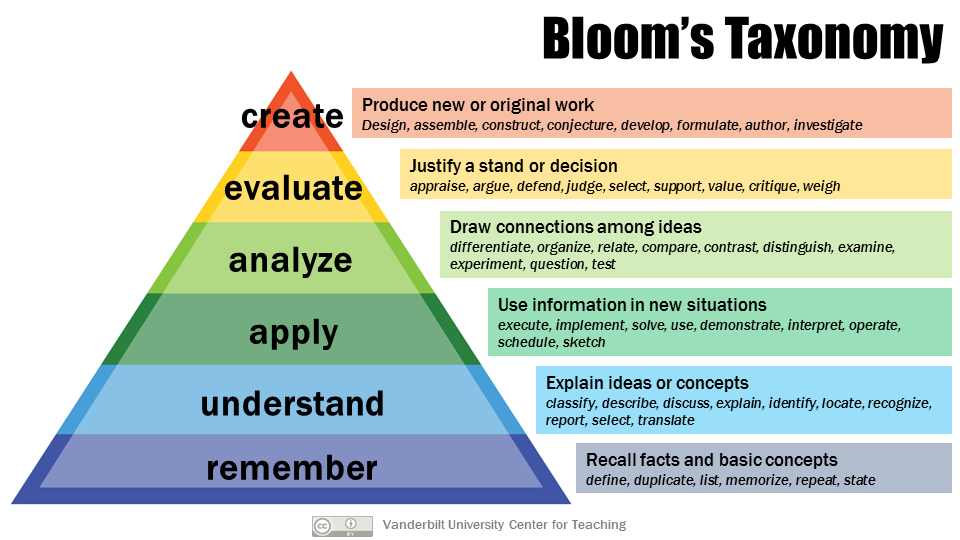
The Six Levels of Bloom’s Taxonomy Explained for Corporate Trainers
1. Remember: The Foundation of Learning 🧠
Explanation: The “Remember” level involves recalling facts, terms, and basic concepts. 📝 In corporate training, this could mean ensuring that learners remember key terminology, procedures, or foundational concepts. It’s the groundwork upon which deeper learning is built. Additionally, it’s worth noting that “remember” is the most widely used level of Bloom’s Taxonomy, but also the most basic. 🛠️
Use Case: When training employees on a new software tool 💻, trainers should first ensure that learners can recall the names of different features, key functions, and relevant vocabulary. Since this level is all about memory, repetition, quizzes, and quick Q&A’s can be useful tools at this level. 🗂️📝
2. Understand: Connecting the Dots 🔗
Explanation: At the “Understand” level, learners go beyond remembering; they comprehend the meaning behind the information. 🧩 So in the corporate world 🌍, this is where trainees understand why certain processes, behaviors, or tasks matter.
Use Case: For compliance training, instead of simply listing regulations 📜, a trainer can explain why these regulations are in place. Case studies or storytelling 📖 can help employees see the real-world impact of adhering to or ignoring these rules. Therefore, helping them understand the “why” behind the information encourages adoption at this level. ✅
3. Apply: Using Knowledge in Real Situations ⚙️
Explanation: In the “Apply” phase, knowledge is tested by how well it can be adapted and executed in new scenarios. 🌍As a result, it’s important for corporate trainers to help learners practice applying their skills in new and unpredictable environments. 🧠
Use Case: For instance, in customer service training, first train employees about customer engagement. Then guide them through scenarios where they have to apply their newly acquired customer engagement skills to resolve a customer complaint in real time. Skills practice (role-plays) are particularly powerful tools at this level. 🎭
4. Analyze: Breaking It Down 🔍
Explanation: The “Analyze” level involves breaking information into parts to explore relationships and patterns. Which, in corporate training, helps learners understand how different components interact and contribute to the bigger picture 🖼️.
Use Case: In leadership training, you could provide a case study of a failed project 📉 and ask learners to analyze what went wrong. By dissecting each component of the project, participants can identify and understand the root causes. 🌱Then debrief that activity and challenge them to use the knowledge to prevent similar issues in the future.
5. Evaluate: Making Judgments ⚖️
Explanation: At the “Evaluate” level, learners are required to make judgments based on criteria and standards. 📝 This could mean critiquing a process, assessing performance, or deciding the best course of action.
Use Case: During a project management workshop 📊, participants could be asked to evaluate different project proposals. By comparing them against predefined criteria such as budget 💰, timeline ⏳, competing priorities, and feasibility, they learn how to weigh the pros and cons and make informed decisions. 🧠 Furthermore, it is your responsibility as the facilitator to evaluate participants’ evaluations. Very meta, I know. 🔄
6. Create: Building Something New 🛠️
Explanation: The final and top-level “Create” is about constructing something new by combining elements of information or concepts in a novel way. 🔧 This could translate to the corporate world by encouraging employees to use their creativity and knowledge to develop new ideas, processes, or products.
Use Case: After a creative strategy workshop💡, employees could be asked by the facilitator to come up with innovative approaches for improving customer experiences. Subsequently, this could lead to developing new customer engagement techniques or reimagining the experience customers have on your website 💻.
Limitations of Bloom’s Taxonomy in Workplace Learning
Bloom’s taxonomy is a 70-year-old model and is a product of its time. Very few things that were built in the 1950s have stood the test of time with no revisions, and Bloom’s is no exception. Subsequently, there are a handful of shortcomings to consider when applying the taxonomy to corporate training.
First, the model was never intended for an audience of corporate learners. Specifically, it was developed for primary and secondary education. Moreover, it was desined primarily with pedagogy in mind because Malcolm Knowles didn’t popularize androgogy and adult learning theory until the 1960’s. For more on that, check out this post.
Secondly, most corporate training doesn’t move past the “apply” level. Equally as important, most corporate training doesn’t need to move past the “apply” level. At least with the types of training most companies are investing in now. That isn’t to say that we shouldn’t be moving into higher levels, just that we don’t.
Lastly, the strict hierarchical structure may just not fit as well with what and how people learn in this day and age. Technology does a lot of the heavy lifting in the understanding stage. We need to know a lot less about a lot more things. Most companies are more concerned with outcomes and production from the vast majority of their workforce. Meaning there’s little appetite for their front line workers to be operating at an evaluation, or create level.
Real-World Examples of Bloom’s Taxonomy in Corporate Training
Now that we’ve covered each of the different levels of Bloom’s Taxonomy, let’s look at how trainers can apply these levels in a few common types of corporate training to create impactful training sessions. Also, keeping in mind some of Bloom’s shortcomings. ⚙️
-
Employee Onboarding 👩💼👨💼
For new employees, onboarding can be overwhelming (often due to how underwhelming the onboarding program is), with lots of new information to absorb. 🌊 Bloom’s Taxonomy can help structure the onboarding program in a way that ensures effective learning:
- Remember: Start with basic facts, such as company history, mission, and values. 🏛️
- Understand: Help new hires understand their role within the company and how their work contributes to broader company goals. 🌐
- Apply: Give them simple tasks that apply what they’ve learned, such as using internal tools to complete assignments. 🖥️
- Analyze: Encourage them to evaluate a company procedure or analyze a sample customer scenario. 🔍
-
Compliance Training 📋⚖️
Compliance training can be dull if it simply involves memorizing regulations. Using Bloom’s Taxonomy may not make it more fun, but maybe more impactful:
- Remember: Learners recall key rules and guidelines. 📑
- Understand: They understand why these regulations exist and their importance through discussion or written assignments. 💡
- Apply: They practice applying rules through case studies and scenarios. 📝
-
Sales Training 💼💬
Sales training is most effective when it encompasses all levels of Bloom’s Taxonomy:
- Remember: Ensure that trainees memorize key sales terminology and product details. 🛍️
- Understand: Help them understand buyer personas and the customer journey. 🚶♂️
- Apply: Practice sales techniques through mock sales calls. 📞
- Analyze: Break down successful sales calls versus unsuccessful ones to understand the factors that made the difference. ⚖️
- Evaluate: Evaluate a sales pitch to determine its strengths and weaknesses. 🎯
- Create: Challenge trainees to create their own pitch for a new product or a different type of customer. 🗣️
-
Leadership Development 🏆👥
To develop leaders, training must go beyond superficial skills:
- Remember: Start with leadership theories and essential skills like empathy, change management, or effective communication. 💼💡
- Understand: Have trainees understand the impact of different leadership styles. 🧠
- Apply: Use real-world scenarios to apply leadership skills, like preparing for a real coaching session. 🎯
- Analyze: Encourage participants to analyze different leadership approaches in case studies or their own coaching approach. 📊
How Corporate Trainers Can Apply Bloom’s Taxonomy Effectively
- Incorporate Multi-Level Learning Activities: Ensure that your training sessions include activities from each level of Bloom’s Taxonomy when appropriate. For example, after presenting new information (Remember) 🧠, engage trainees in a discussion 💬 to deepen their understanding and follow up with activities that require them to apply the knowledge.
- Use Scaffolding to Build Learning: Design activities that progressively build on previous knowledge 📈. Start with lower-level cognitive skills and gradually work your way up to creating and evaluating 🏗️. This ensures learners have the foundation they need before they engage in higher-order thinking tasks.
- Encourage Reflection: At the “Evaluate” stage, encourage trainees to reflect 🤔 on their learning experience. What worked well for them? What would they do differently next time? Reflection not only reinforces learning but also helps learners internalize what they’ve learned.
- Promote Real-World Application: The “Apply” stage is critical for bridging the gap 🌉 between theoretical learning and real-world practice. Provide learners with opportunities to use what they’ve learned in practical scenarios, whether through role-playing 🎭, simulations, or real-world projects. The closer you get to real-world scenarios, the more impactful the training will be.
Conclusion: Why Bloom’s Taxonomy Still Matters in Corporate Training
Benjamin Bloom’s Taxonomy offers a useful framework for understanding how learning progresses from basic knowledge to complex creation 🚀. Generally, levels one through three are going to be the most widely used in corporate training. While the higher levels can be reached in corporate, it would typically be through facilitated workshops with experts on a particular topic or in a certain field. As such, you shouldn’t beat yourself up for not being able to get your learners to the create level in an onboarding course.
So familiarize yourself with the principles of Bloom’s taxonomy, but don’t approach it as a one-size-fits-all model that will ensure your training lands. How do you use Bloom’s Taxonomy? What has worked for you? I’d love to hear from you. Until then.💪🎓
When you’re ready, here are some ways I can help:
Corporate Trainer Workshops
Need to upskill your team on a specific live or virtual training topic? I’ll work with you to identify the needs of your team and facilitate a hands-on, workshop. Where you need it. When you need it. How you need it.
Consultation and Coaching
Need advice on a training project, your development process, or leading a training team? How about landing your next facilitator job? I’ll consult with you and help you be successful.
Custom Instructor-Led Training Development
Transforming your learning objectives into engaging and effective instructor-led trainings. Virtual or live, from development to train-the-trainers, we have your training needs covered.